


It sure is an exciting time for the nimble and innovative! With mainstream adoption, the Internet and social media have pervaded every aspect of our lives. In the classroom, the Internet is helping teachers to expand beyond linear, text-based learning, and to engage students who learn best in other ways. Its role in schools has evolved from a contained “computer class” into a versatile learning tool that could change how we describe and demonstrate concepts, assign projects, and evaluate progress.
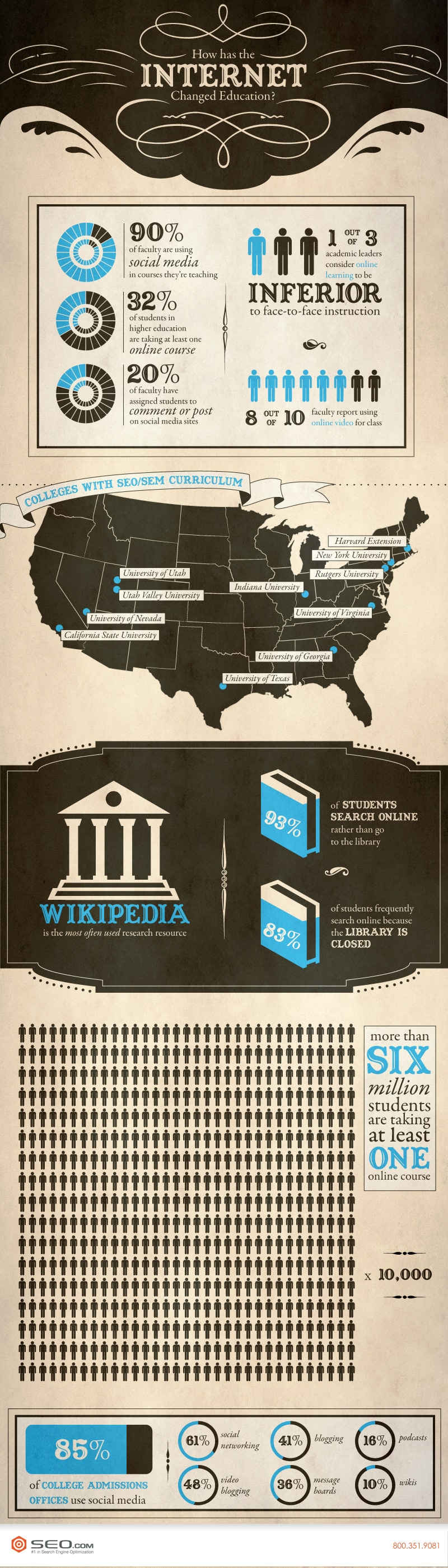
This infographic shows how the Internet has enriched and dramatically changed the methodology of both teaching and learning. Recent data reveals that 93 percent of college students, when confronted with a research problem, turn to search engines like Google or Yahoo to get information rather than going to the library. Regardless of faculty discouraging its use, Wikipedia has become the most used research resource.
It is estimated that 90 percent of faculty use social media in their courses, 8 in 10 utilize online videos in classes, and 85 percent of admissions offices reach out to potential students via some sort of social media and video blogging. Colleges are now adapting their curriculum to include coursework for search engine optimization and search engine marketing. Will mobile learning be the next technological paradigm shift to take place in education? It very well could be if leaders in academia already look to mobile platforms to enhance the overall teaching and learning experience.
Students can now decide to obtain a complex degree with the internet. Even a seemingly difficult degree like an LL.M. (Master of Laws) in Taxation can be achieved online. Applying for a program like those offered by Gwynedd Mercy University is just slightly more complicated than setting up a Facebook account, so there is no reason to feel intimidated. As long as you have the dedication and passion to learn, you can use the internet to achieve nearly any degree.
Click Infographic To Enlarge
Infographic Credit: [SEO] Header Image Credit: [Principles of Marketing]
COMMENTS